
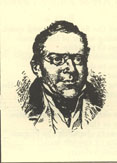
CARL CZERNY

21th Febuary 1791 --- 15th July 1857

KARL CZERNY was born in Vienna, February 21, 1791· From Wenzel Czerny, his father, a Bohemian by birth, he inherited the Bohemian accent that marked his speech for life; and from his  father he received pianoforte lessons almost as soon he could move his fingers. He play little pieces when he was four  years old, and at the age of fourteen he gave lessons.

In 1800, according to Eiserle he played in public the C minor concerto of Mozart.  His father and Wenzel Krumpholz took him to see Beethoven, one winter day of that same year.
There was a group of men in an untidy room of a house in the ''Tiefen Graben. " One of the group had shaggy, pitch black hair, which stood  on end; he wore a beard of a week's growth, his rough clothes, of a hairy stuff, made the boy think of Robinson Crusoe.  This man was Beethoven, who then heard Karl play Mozart's C major concerto and the "sonate pathetique." He said to Wenzel Czerny, the modest musician, "your son has great talent. I will be his teacher.   Send him here twice a week, and let him bring Philipp Emanuel Bach's 'True Method of playing the Clavier.

Thus began the instruction which lasted until Karl was fourteen yeats old.  In a written certificate Beethoven spoke of his "extraordinary progress and remarkable memory.  He sent his nephew Karl to him for the study of the pianoforte, he entrusted him with the arrangement of "Leonore" for the pianoforte, and with other important work.

In 1806 Czerny played Beethoven's C major concerto in public, in 1812 he was the pianist when the noble concerto in E flat was heard for the first time and Theodor Korner recorded the fact that it was a failure, and during the years 1818, 1819 and 1820 he gave recitals at his lodgings every Sunday from 11 till 1 o'clock, which were devoted to the pianoforte compositions of his master, and to which all lovers of music were welcome.

But teaching and composition soon absorbed his time. It is said that his playing in his youth was characterized by brilliancy,  and Fetis states that if Czerny had devoted himself solely  to concert work he would have been one of the first of the virtuosos, and others, among them Hanslick, say that his performance was without any display of artistic fire.

With the exception of short trips to Leipzig, Paris. London and other towns, he passed his life in Vienna.     He taught for ten or twelve hours a day until about twelve years before his death, and these last years were spent in composition and in the arranging of the works of others.

His health failed him in 1854, and he was loath to leave his rooms. A gouty swelling first attacked his arm, which was encased in plaster.  He composed although the disease spread 

  His last works, an offertorium and a sonata, I were written fourteen days before his death, which took place July 15th 1857.

Czerny was small and frail. He was unassuming and amiable in company. He preferred to seclude himself, for he was a man of incredible industry. Music was to him I "his only joy, his only occupation, his daily duty and his highest ideal." Until his sickness mastered him, the little man with golden spectacles and a large, round snuff-box was to he seen at noon in Diabelli's music-shop, where he would converse affably.

His habits were simple, his life and speech were of uncommon purity.  He was not without literary tastes, and a comedy, two dramas and verses by him are in the archives of the "Gesellschaft der Musikfreunde,"  in Vienna. He was accused, but undoubtedly with gross injustice, of avarice.  His kindly deeds were remembered by many. He left a fortune of 100,00 florins. As he was never married and was without kin, he willed the money, with the exception of trifling legacies, to charitable institutions.

He was as fortunate in his pupils as they were in their master. Among the most celebrated were Emilie Belleville-Oury ( 1808- 1880) ; Theodor Dohler (1814-1856) ; Theodor Kullak (1818- 1882) ; and Franz Liszt (1811-1886). Although the instruction that Czerny received from Beethoven was irStevenular, it was the foundation of his own teaching. " In the first lessons," said Czerny, "Beethoven busied himself exclusively with the scales in all the keys. He showed me things that were then unknown to most players, the true position of the hands and the fingers, and the use of the thumb. I learned the full value of these rules only in later years.

He was very particular about the legato." We are told of Czerny's course with Liszt, who in 1821, as an infant prodigy, so won the sympathy of the teacher that he taught him for a year and a half without reward of money, and loved him as a brother. He insisted on ''a well-exercised touch and correct execution in moderate time. He taught, in his usual systematic manner, artistic technique and correctness of rendering."
Yet it would be wrong to assume that he was merely a master of technique, when such an authority as Brahms declares, in referring to his editions of certain works of Bach and Scarlatti, that "we cannot to-day estimate Czerny's value too highly.''

As a composer, he was first of all a marvel of fertility. Not without reason has he been called the Lope de la Vega of the pianoforte. His works are over 1,000 in number, and many of them embrace 50 or more pieces.

The masses, oratorios, overtures, motets, concertos, symphonies, etc., have not withstood the ravages of Time. Czerny studied composition by reading the treatises of Turk, Kirnberger, Albrechtsberger, and Marpurg, and putting together the voice-parts of the quartets and the symphonies of Haydn and Mozart. He was skilled in composition, but he had little imagination, and hardly any originality.

His enduring monument is the series of studies for the' education of youth, and for varied technical purposes. So  ready was he in composition that he invented at once exercises for the needs of his pupils, suiting the peculiar want of each.

About 1810 he began to publish studies for the use of students, the surpassing merit of which has been gratefully acknowledged by the virtuosos, the pedagogues, and the critics of all countries. For Czerny knew best of all (to borrow an idea from Hugo Riemann) how to expose I clearly the necessary and natural form-foundations on which the structure of pianoforte-music rests. He also had the gift of leading the pupil step by step; and no detail in the art of pianoforte-playing escaped his observation.

PHILIP HALE

The Above was written by Mr hale in 1893 (Steven).

Last Updated on 20th July
By Steven

And now for the Music

I like to thank Emily Gray for sequencing and donating the following piece, to contact Email Emily Gray.

(2583) "Dancing the Jig." Sequenced by Emily Gray

(1216) Etude Op.740 No.19 Sequenced by Reginald Steven Ritchie

(1215) Etude Op.740 No.18 Sequenced by Reginald Steven Ritchie

(1162) Etude Op.740 No.17 Sequenced by Reginald Steven Ritchie

(1095) Etude Op.740 No.16 Sequenced by Reginald Steven Ritchie

(1096) Etude Op.740 No.15 Sequenced by Reginald Steven Ritchie

I like to thank John Scarborough for the following music, you can contact John Here.

(1052) Etude Op.299 No.34 nicely sequenced by John Scarborough

(1009) Etude Op.740 No.14 Sequenced by Reginald Steven Ritchie

(1008) Etude Op.740 No.13 Sequenced by Reginald Steven Ritchie

(983) Etude Op.740 No.12 Sequenced by Reginald Steven Ritchie

(982) Etude Op.740 No.11 Sequenced by Reginald Steven Ritchie

(953) Etude Op.740 No.10 Sequenced by Reginald Steven Ritchie

(952) Etude Op.740 No.9 Sequenced by Reginald Steven Ritchie

(889) Etude Op.740 No.8 Sequenced by Reginald Steven Ritchie

(870) Etude Op.740 No.7 Sequenced by Reginald Steven Ritchie

(863) Etude Op.740 No.6 Sequenced by Reginald Steven Ritchie

(855) Etude Op.740 No.5, this is just a simple piano exercise piece, Sequenced by Reginald Steven Ritchie

(846) Etude Op.740 No.3 Sequenced by Reginald Steven Ritchie

(831) Etude Op.740 No.2 Sequenced by Reginald Steven Ritchie

(813) Etude Op.740 No.1 Sequenced by Reginald Steven Ritchie

(35a) Etude Op.740 No.11 Seq by V Phillips

(36a) Etude Op.740 No.44 Seq by V Phillips

(37a) Etude Op.704 No.50 Seq by V Phillips

(38a) Etude Op.740 No.4 Seq by V Phillips

This page has been visited.--
--


If your interest's match mine or you would like to send in your Classical style compositions in midi file format then please E-mail me at  

classicalmidi (@) gothere . uk . (com) please remove all spaces and brackets to get to my email address, fight against spam.

Back to Classical Midi Main Menu click HERE            

eXTReMe Tracker

                                            BACK TO MY HOME PAGE Classical musical home page
