
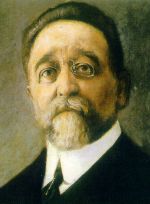

I like to thank Ramon Pajares Box for the picture.
27th March 1851 --- 25th March 1909
Ruperto Chapi was born in Villena (Spain) on 27 March 1851. He began work as a cornet player in his native town band. At age 16 he left Villena to study in Madrid, where he enrolled the Conservatory of Music. At the same time he was a member of the orchestra of two theatres. In 1871 he composed Abel a zarzuela (an opera with spoken parts) which was requested by Emilio Arrieta, his composition teacher at the time, but which was not premiered until 1873. He secured a post as music director in the Artillery Regiment and was awarded with the first prize at the Conservatory, sharing this honour with Tomás Bretón. Later he was awarded a scholarship to the Rome Fine Arts Academy after composing an opera, Las Naves de Cort, which was a notable success at Madrids Teatro Real.
His stay abroad, dividing his time between Rome, Milan and Paris, lasted almost four years. In this period he composed several operas and the oratorio Los Angeles.
In the following two years he composed several zarzuelas: M'fasica cl'e1sica, La calandria, Madrid , Las dos hurfanas, La calle de Carretas, but the work which had the greatest effect on his career was La Tempestad, a resounding success at Teatro de la Zarzuela in 1882. From then on, Chapi's reputation created a veritable idolatry among his supporters.
In 1889, at Arrietas suggestion, participated in a music competition composing Los gnomos de la Alhambra, a symphonic poem that gained notable popularity in Spanish concert societies over the ensuing years. The zarzuelas Las hijas del Zebedeo and El cocodrilo date from the same year. His next great success was El rey que rabi premired in 1891.
Chapi's continued to add more works to his already vast output until the end of his life. A collection of four string quartets is now being rediscovered. However, the idea of writing a magnum opus, a kind of grand lyrical testimony, in defence of a Spanish opera, came from afar, and was one of his life-long struggles. This produced Margarita la Tornera, which was premired on 24 February 1909. A few days later, on 25 March, Chapi died of a heart attack, caused by a bout of pneumonia.
I would sincerely like to thank Ramon Pajares Box, for creating and sending me the above text.
And now for the Music

(772)La Revoltosa (1897), Preludio. Beauitfully Sequenced by Ramon Pajares Box
(773) La Bruja (zarzuela, 1887), Jota, a wonderful sequenced piece by Ramon Pajares Box

If your interest's match mine or you would like to send in your Classical style compositions in midi file format then please E-mail me
atclassicalmidi (@) gothere . uk . (com) please remove all spaces and brackets to get to my email address, fight against spam.
Back to Classical Midi Main Menu click
HERE
