
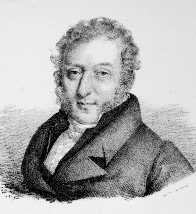
Can someone please provide a picture.
9th February 1770 --- 17th February 1841
Carulli was born in Naples, Italy on February 9th, 1770. His father, Michele, was a distinguished literator, secretary to the delegate of the Neapolitan Jurisdiction. Like many of his contemporaries, he was taught music theory firstly by a priest, who was an amateur musician, and his first instrument was the cello. When he was twenty he discovered the guitar, gave up the cello and devoted his life to the exclusive study and advancement of the guitar. Since there were no real teachers for the guitar in Naples at the time, he developed his own style of playing which he later published in his method, which is the same method that is used today (in part) by most when teaching the classical guitar.
His local concerts in Naples were so popular that he soon began touring Europe, performing. Around 1801 Carulli married a French woman, Marie-Josephine Boyer, and their son, Gustavo, was born. A few years later Carulli started to compose in Milan, where he published some of his works for local publications. In 1808, due to his immense popularity whilst touring in Paris previously, Carulli moved to Paris, which was at the time the 'music-capital' of the world, and where he stayed for the rest of his life.
Here he became a very successful musician and teacher, mainly due to the fact that he was probably the first guitarist in Paris to make classical guitar fashionable. His original intention for moving there was to publicise the guitar among the high-class and other musicians in Paris. His performances caused great comment among artists. It was also here where he published most of his works, eventually becoming a publisher himself and printing the works of other prominent guitarists. His teaching method was new and fresh, and helped the general public to accept guitar music and made people more interested in it.
In the 1830's, many guitarists followed his example and came to Europe, mainly from Italy like himself, who were "attracted by his personality". With so many guitarists now in Paris, Carulli worked harder at his teaching, and soon had students from the nobility and of the Parisian upper-class.
Many of Carulli's greatest pieces he offered to publishers were turned down as being too hard for the average player; the publishers wouldn't risk their reputations by buying his works. Many masterpieces were lost in this way. This is no doubt part of the reason why he started publishing himself. However, the great majority of Carulli's works that have been published were only those that the other publishers would risk publishing, that is; the easier, less challenging and generally less interesting ones, mainly for learners of the guitar. Although he had numerous supporters in the form of students, and his own reputation was great, he began to believe he didn't deserve this reputation because most of the great works he had composed were never published.
Confined to mainly easy pieces, Carulli wrote his world-famous method of classical guitar, "Harmony Applied to the Guitar", a collection of pieces that are still used today in tuition. At the time of publishing, the method was very popular and sold well and had many editions published. Although this was not really the sort of thing he wanted to write, it was infinitely superior to anything else similar in that field published before.
Later in life, he began to experiment with changes in guitar construction. With Lacote, a French guitar maker, he made some significant changes for improving the sound of the guitar.
He died in Paris on February 17th, 1841, at the age of 71 years.
Carulli was among the most prolific composers of his time; he wrote about four hundred works for the guitar, and countless others for various instrumental combinations, always including the guitar. For example, among others, Carulli wrote serenades for flute, violin and guitar, flute and guitar, violin and guitar, voice and guitar, guitar solos and with piano, even concertos for guitar and orchestra. His most influential work of all was his "Method, op. 27" published 1810, and still used widely today in training students of the classical guitar. Carulli also composed some pieces for guitar and piano with his son Gustavo. He wrote works for chamber orchestra and other ensembles.
Carulli is one of the most influential classical guitarists in history. Aside from his immensely influential Method, published in the early 1800's and still used widely today as a means of teaching students of the classical guitar and helping experts to perfect certain techniques, he helped to physically change and improve many aspects of the guitar to make it the one we know today.
At Carulli's time, the early 1800's, the guitar had evolved from a lute-like instrument with five pairs of strings to an instrument close to the guitar we know today, with a flat body, long neck and circular sound hole in the middle. It was, however, different in many ways. Carulli's first guitar may have had not six single strings but possibly five, and possibly in pairs which would have made strumming sound good but not so good for the picking action that is used in classical guitar. Also, the body of the instrument would have been smaller with less surface area, which caused the sound to be less resonant and more like that of a violin or ukelele being plucked. Finally, the tuning pegs of the guitar were not mechanical but frictional, like those of cellos, an aspect that was only changed about a hundred years ago, well after Carulli's time. In the later part of his life, Carulli, along with French instrument makers and guitarists Antonio de Torres Jurado and Lacote, helped to change the guitar into the larger, more resonant instrument we know today. They accomplished this by making the bulges or bouts in the side more pronounced, to produce a greater volume and surface area which made the sound better. Later Jurado also helped to make the modern form of the flamenco guitar which is lighter and smaller with a more brilliant sound than the classical.
I would like to give my grateful thanks to Ruth, who has done a wonderful job on the above biography, please email Ruth just to say thank you, or if you wish visit her WEB SITE.
Ferdinando Maria Meinrado Francesco Pascale Rosario Carulli was one of the most famous of composers for classical guitar, and many of his four hundred pieces plus are still used today to help beginners learn the guitar and experts perfect certain techniques. He is also considered one of the best teachers of guitar in history.
Last Updated on 4th December 1999 by Steven
And now for the Music

(837)"Opus 120, Andante in C", Sequencer Unknown
(814)"Opus 120 Andante in C" another movement from this piece Sequenced by ?
(760)"Five Romances for two Guitars, Sequenced by Trent Hanson
(843) "Siciliana" Sequenced by R.Fennimore

If your interest's match mine or you would like to send in your Classical style compositions in midi file format then please E-mail me
atclassicalmidi (@) gothere . uk . (com) please remove all spaces and brackets to get to my email address, fight against spam.
Back to Classical Midi Main Menu click
HERE
