
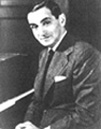
IRVING BERLIN (ISRAEL BALINE)

Thanks go to David SM Knopf for providing the photo.

11th May 1888 --- 22nd September 1989

Original name ISRAEL BALINE (born 1888, Mogilyov, Russia [now in Belarus]--died 1989, New York, N.Y., U.S.), American composer who played a leading role in the evolution of the popular song from the early ragtime and jazz eras through the golden age of musicals. His easy mastery of a wide range of song styles, for both stage and motion pictures, made him perhaps the greatest and most enduring of American songwriters.

Israel was born to the family of a Jewish cantor that immigrated to New York City in 1893. His father died when the boy was eight years old. Having obtained only two years of formal education, he worked as a street singer and a singing waiter in New York's Lower East Side. He began writing song lyrics, and his first published song, "Marie from Sunny Italy," appeared in 1907; a printer's error on this song named him Irving Berlin, a surname that he subsequently kept. Berlin continued his writing and within a few years was a successful "song plugger," demonstrating new tunes.

He was unable to read or write musical notation and learned music by ear instead. He began writing his own music as well as lyrics, and in 1911 he wrote what quickly became the preeminent hit of Tin Pan Alley's ragtime vogue, "Alexander's Ragtime Band." His first ballad, "When I Lost You," was written in 1912. Then he began contributing to numerous Broadway revues and musical entertainments, including Florenz Ziegfeld's Follies. In 1919 he founded the Irving Berlin Music Corporation to publish his own music.

Through the following decades Berlin wrote the scores for several musicals, one of his most popular beingAnnie Get Your Gun (1946; film, 1950). He wrote more than 800 songs, many of which became classics, including "Oh, How I Hate to Get Up in the Morning," "A Pretty Girl Is Like a Melody," "Always" (written in 1925 as a wedding present for his second wife), "Remember," "Cheek to Cheek," "How Deep Is the Ocean," "Blue Skies," "Puttin' on the Ritz," the patriotic standard "God Bless America," "Heat Wave," and "There's No Business Like Show Business." In the era of big motion-picture musicals, Berlin was able to transfer his stage success to the screen, writing the scores for many successful films, including Top Hat (1935), Follow the Fleet (1936), Easter Parade (1948), Call Me Madam (1953), and White Christmas (1954). His score for the film Holiday Inn (1942) introduced the touching ballad "White Christmas," which became one of the most popular songs ever recorded. Altogether Berlin wrote the scores for 19 Broadway shows and 18 motion pictures.

Copyright 1994-1998 Encyclopaedia Britannica

Last Updated on 20th October 2001
By Reg

And now for the Music

My grateful thanks go to JP for this piece. Email JP and let him know how much you like the music,

(2305) "Smile and show your Dimple" Sequence & donated by JP

(956) A selection from "A White Christams" A beautiful sequence. Sequencer George Pollen

(609) "Puttin' on the Ritz" Seq by ?

(50a) Alexanders Ragtime Band Seq by Sue Keller

This page has been visited --
--


If your interest's match mine or you would like to send in your Classical style compositions in midi file format then please E-mail me at  

classicalmidi (@) gothere . uk . (com) please remove all spaces and brackets to get to my email address, fight against spam.

Back to Classical Midi Main Menu click HERE            

                                             BACK TO MY HOME PAGE Classical musical home page
