
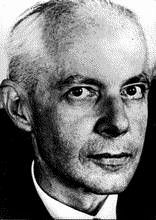
Bela Bartok page with free midi's to download

BELA BARTOK

25thMarch 1881 --- 26thSeptember 1945

Bartok, Bela (1881-1945), Hungarian composer and pianist, born Nagyszentmiklos. He first learnt music from his mother
a schoolmistress who  became a widow when  he was 8. They moved from place to place until 1894, when they settled at
Pozsony (Pressburg, now Bratislava), where he studied with L. Erkel.

In 1899, by which time he had  already played the  piano in public, he entered the Budapest Academy of Music as a pupil
be influenced  in turn by Liszt,  Brahms and Wagner, and in  1902 he  came under the  spell of Richard Strauss for a short
time, but later he  repudiated all  his early works,  the first he acknowledged,  and labeled Op.  1, being the Rhapsody for
piano  and  orchestra of  1904. About  1905 he began to  realise that  what had so far passed as Hungarian folk music and
been used  as  such by composers like  Liszt,  was really Gypsy music,  and that the true Magyar  peasant music was quite
different. He began to collect and publish  folk-songs with Kodaly  (q.v.).  Then in 1907 he became  piano professor at the
Academy.  His success as a composer was retarded by the often uncompromising harshness of his first mature works, but
in 1917 his ballet The Wooden Prince and in 1918 his opera Bluebeard's Castle were produced.

Soon afterwards  due to the political changes in Hungary brought him new difficulties; yet despit this his importance was
recognised  by  1923,  when he  was commissioned to  write an  rchestral work for  the 50th  anniversary of  the  union of
Buda  and  Pest, when  he produced  the Dance Suite.  In 1927 he toured  the U.S.A.  and in  1929  Russia.  Meanwhile  his
interest in folk  music had extended to  Rumanian and Arab music, and in  1934, when he  resigned from the Academy, he
was engaged by the Hungarian Academy of Arts and Sciences to prepare folk-song collections for official publication.

The  events  of the Second  World  War made  life  in Hungary  politically intolerable  to Bartok and in  1940 he  decided to
emigrate to America.  But owing to  ill-health he found  it impossible to obtain profitable employment there, and his pride
forbade him to accept money which he did not feel he had earned. He died in penury in New York on 26 Sept. 1945.

His music may be said to fall into 4 periods a first including the immature early works he discarded, a second in which the
influence  of earlier  composers  gradually  gives  way to  that of folk music,  a third  (including the  middle string quartets
the 2nd piano concerto and the Cantata profana), where experimentation becomes often ruthless and disconcerting and a
fourth showing a beautiful clarification of  style, without any sacrifice of individuality and enterprise, in such works as the
3rd  Concerto,  the Sonata  for  2 pianos  and percussion, the  Concerto for  Orchestra, the 6th  Quartet and  the Music  for
Strings, Percussion and Celesta.

Last Updated on April 2025
By Steven Ritchie

And now for the Music

Real time Sequenced from Piano Competition 2006, below..

NEW (4647)"Etude, Op.18, No.2". Real time Sequenced by Mikhail Mordvinov.

NEW (4646)"Etude, Op.18, No.1". Real time Sequenced by Mikhail Mordvinov.

Thanks to Chris Todd for the music below, Email(CSharpMin @ aol.com)

(3440)"Mikrokosmos Opus.22, No.143, Divided Arpeggios". Sequenced by Chris Todd.

(3439)"Mikrokosmos Opus.22, No.146, Ostinato". Sequenced by Chris Todd.

(3438)"Mikrokosmos Opus.22, No.146, Ostinato". Sequenced by Chris Todd.

(3437)"Mikrokosmos Opus.22, No.152, Six Dances in Bulgarian Rhythm No.5". Sequenced by Chris Todd.

Thanks to Nicolas Iline for the music below, Email(niline309@)gmail.com)

(3381)"Piano Concerto No.3, Mov.1". Sequenced by Nicolas Iline.

(3380)"Piano Concerto No.3, Mov.2". Sequenced by Nicolas Iline.

(3006)"Piano Concerto No.2, Mov.1". Sequenced by Nicolas Iline.

(3007)"Piano Concerto No.2, Mov.2". Sequenced by Nicolas Iline.

(3008)"Piano Concerto No.2, Mov.3". Sequenced by Nicolas Iline.

(3003)"Piano Concerto No.1, Mov.1". Sequenced by Nicolas Iline.

(3004)"Piano Concerto No.1, Mov.2". Sequenced by Nicolas Iline.

(3005)"Piano Concerto No.1, Mov.3". Sequenced by Nicolas Iline.

Thanks to Tony Matthews for the music below, Email(TonyM@absolutesolutions.co.uk)

(2489)"Ten Easy Piano Pieces, Dedication Mov.0". Sequenced by Tony Matthews.

(2490)"Ten Easy Piano Pieces, Peasant's Song Mov.1". Sequenced by Tony Matthews.

(2491)"Ten Easy Piano Pieces , Painful Wrestling Mov.2". Sequenced by Tony Matthews.

(2492)"Ten Easy Piano Pieces, Slovak Peasant's Dance Mov.3". Sequenced by Tony Matthews.

(2493)"Ten Easy Piano Pieces, Sostenuto Mov.4". Sequenced by Tony Matthews.

(2494)"Ten Easy Piano Pieces, An Evening at the Village Mov.5". Sequenced by Tony Matthews.

(2495)"Ten Easy Piano Pieces, Hungarian Folksong Mov.6". Sequenced by Tony Matthews.

(2496)"Ten Easy Piano Pieces, Aurora Mov.7". Sequenced by Tony Matthews.

(2497)"Ten Easy Piano Pieces, Hungarian Folksong Mov.8". Sequenced by Tony Matthews.

(2498)"Ten Easy Piano Pieces, Finger-Exercise Mov.9". Sequenced by Tony Matthews.

(2499)"Ten Easy Piano Pieces, Bear Dance Mov.10". Sequenced by Tony Matthews.

(1308)"Music for String Instruments, Percussion and Celesta, 2nd mov". Sequenced by Dr David Siu

(1309)"Music for String Instruments, Percussion and Celesta, 4th mov". Sequenced by Dr David Siu

(30a)"Courting Song". Sequenced by Rob Dwyer

(31a)"Children's piece No.2". Sequenced by Faren Raborn

1310)"Piano Sonata Mov.1". Sequencer Unknown

(1311)"Piano Sonata Mov.2". Sequencer Unknown

(1312)"Piano Sonata Mov.3". Sequencer Unknown

(23a)"Mikrokosmos". Sequencer Unknown ?

(361)"A Rumanian Dance No.1". Sequencer Unknown

If you done any Classical pieces of say for example, Delius, mozart, and so on etc,

please email them to the classical music site with details to

"classical   (@)    ntlworld.com" (written this way to stop spammers)

just remove spaces and brackets for email address), thank you.

Visitors to this page --

Back to Classical Midi Main Menu click "HERE"            

eXTReMe Tracker


© 1997 - 2025 by Webmaster 2000. Please note all MIDI pieces are © by the sequencer, so please email them if you wish to use them on your Non-Commercial site.

You have my permission to use my own sequenced pieces, so long as due credit is given and a link back to this site..