
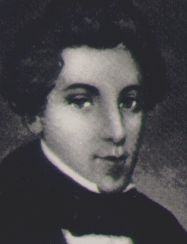

My thanks go to Ramon Pajares Box for the picture?
1806 --- 1826
Juan Crisostomo Arriaga was born in Bilbao on 27 January 1806 - 50 years to
the day after Mozart. His father, Juan Simon, was a wealthy merchant and
trained musician who encouraged his son's exceptional musical and artistic
talents. At 11 he started composing major chamber, orchestral and choral
works, the most remarkable of which was a two-act opera 'Los Esclavos
Felices', written at the age of 13 and successfully performed in Bilbao.
When Arriaga was 16 he was sent to study at the Paris Conservatoire where
the Principal, Cherubini, judged Arriaga's choral work 'Et Vitam Venturi'
(now lost) to be a masterpiece. He absorbed all the principles of harmony
and counterpoint in only three months and two years later, aged 18, he
became the youngest professor ever appointed at the Conservatoire.
Arriaga's feverish creativity appears to have undermined his health and
towards the end of 1825 he began to suffer from an unspecified illness,
probably tuberculosis. He died in Paris on 17th January 1826, ten days
before his 20th birthday, and was buried the same day in a communal grave
in the Montmartre cemetery. His works, which remained largely unknown for
the next hundred years, are now being published and some, notably the three
fine string quartets and the powerful Symphony in D major, have been
recorded several times. Other works include the cantatas 'Agar', 'Erminia'
and 'Edipo' and 'All'Aurora' , three caprices for piano, two sets of
variations and several shorter orchestral pieces.
Arriaga's music is notable for its exceptional fluency, power and technique.
The overture to 'Los Esclavos Felices', written before his training in
Paris, demonstrates his outstanding creativity. Sadly, the rest of this
opera, Arriaga's largest work, appears not to have survived apart from a few
fragments.
His opera Los Esclavos felices (The Happy Slaves) has recently been republished and his three Quartets are still played today. A Symphony, a Cantata and various religious works complete the oeuvre of a very talented composer with a undeniable gifts of freshness and grace, who was known in his time as the Spanish Mozart.
Although he was a contemporary to Beethoven and Schubert his style is more akin to earlier classical period composers.
My sincere thanks go to Herbie for sending me the above bio information on Arriaga.
Last Updated on 12th November 2003
And now for the Music

Symphony in D (1826). Adagio, Allegro vivace, another beautiful piece. This is a large file please click here for pkunzip,
a wonderful sequence by Ramon Pajares BoxSymphony in D (1826). Adagio. Allegro vivace, 2. Andante, a wonderful sequence by Ramon Pajares Box
Symphony in D (1826). Adagio. Allegro vivace,3. Minuetto, a wonderful sequence by Ramon Pajares Box
Symphony in D (1826). 4. Allegro con moto, another beautiful piece, This is a large file please click here for pkunzip.
, a wonderful sequence by Ramon Pajares Box(557) The Overture of the opera "Los Esclavos Felices"(The Happy Slaves). Donated and sequenced by Ramon Pajares Box This is a large file please click here.

If your interest's match mine or you would like to send in your Classical style compositions in midi file format then please E-mail me
at(classical (@) ntlworld . com) please remove all spaces and brackets to get to my email address, fight against spam.
Back to Classical Midi Main Menu click
HERE
